
Stormen is an art installation by Per Fronth, built around a sailboat mounted on a mechanical platform that moves according to real wave data from the North Sea. The audience walks around the sculpture in a large room, while a multi-channel sound system carries music and soundscape through the space.
In the first post about Stormen, I wrote about the technical systems behind the installation, the synchronization between platform and playback, and the multi-channel setup built to carry sound through the room. This post turns to the other half of the work, the question of how to develop the sonic identity of this piece, and what it asked of me as a composer and sound designer.
Before any production started, I had a discussion with Per Fronth about what the piece could be, and more importantly what it should not be. We agreed early that it shouldn’t lean on strictly musical scoring, and it shouldn’t rely on purely diegetic sound effects either. Instead we wanted something more abstract, a rendering of sound and vague tonal content that hints at an emotional quality while still leaving room for interpretation. Through these conversations, I got a feel for where the boundaries sat, and went on to develop the sonic language for the project.
The music is structured in three acts, built on a simple division: past, present, and future. Each act’s internal structure is informed by the dynamic contour of the boat’s own movement, the way its intensity rises, plateaus, and falls across a sequence., This shape acts as the backbone for the musical arc within each act.
Act 1, the past, is melancholic and worn, a whisper carried on the wind. I wanted it to sound fragile yet dignified, an ode to old wisdom and to the shoulders we stand on. I leaned on instruments with a long human history, kept deliberately diffuse, so the material feels like a memory rather than a statement.
Act 2, the present, follows a life cycle, timed to the platform’s own rise and fall. It opens agile and hopeful, moves through the chaos of being born and weathering the storm of life, settles into a kind of incubation, and rises again out of that turmoil before closing on a quiet moment of reflection. Here I turned to more naturalistic sources, water, heartbeats, organic matter, and leaned into the contrast between hope and hardship that runs through most lives.
Act 3, the future, is the most abstract of the three, and follows the sharpest contour of the three acts. It draws on electromagnetic recordings, synthetic and glitching textures, and withholds tonality almost entirely until the very end, when the platform’s movement peaks and massive fog-horn-like gestures rise with it to a climax. The future is unknown, and I wanted the sound to carry that uncertainty, along with a clear technological edge.
Each act carries its own diegetic world too. The past uses wind and the scrape of sand and debris, conjuring ruin and fading memory. The present uses water, bubbles, and organic matter, evoking living things. The future turns to metal, noise, and industrial textures. The boat itself takes on a different character in each act, shifting alongside the music around it.
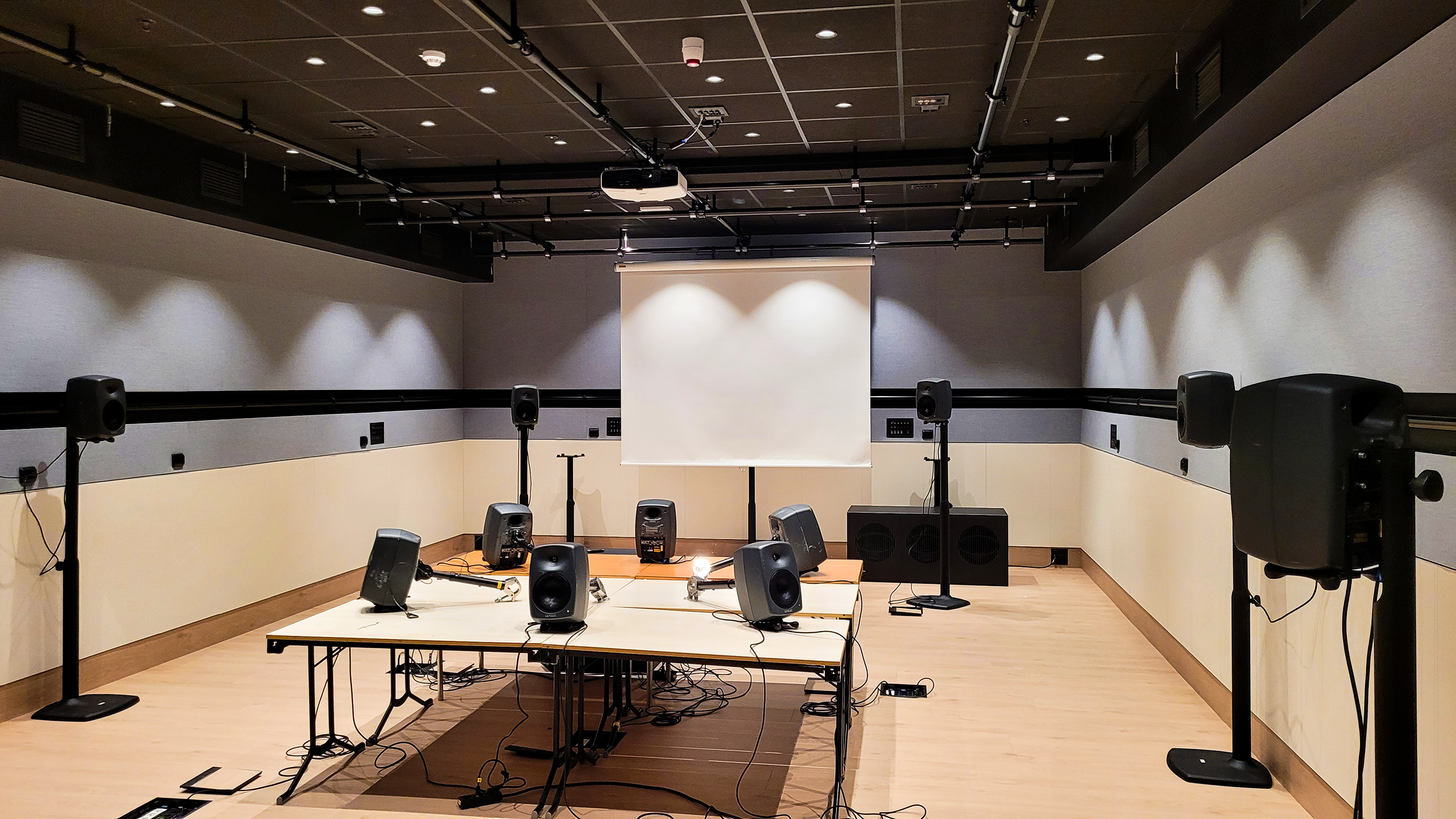
The twelve-speaker system described in my last post turned out to shape the music far more than I expected. Six speakers surround the boat and point outward, six more are placed along the perimeter of the room and point inward, and together they behave as a dynamic quadraphonic array. Wherever a listener stands in the room, they remain inside a quadraphonic field, and the whole system can scale up or down depending on the space available.
That gave me something I don’t normally get as a composer, the chance to score for the room itself rather than for a fixed stereo image. The inner and outer circles were given distinct roles from the start. The inner ring, close to the boat, carries the more intimate and diegetic material, sound that feels like it belongs to the vessel and its immediate surroundings. The outer ring, further out in the room, carries the surrounding field, the ambience and the musical material that needs space to expand. Writing with that separation in mind meant thinking constantly about where in the room a sound should live, and how it should move between the two rings as the intensity of a scene builds or falls away.
The hardest part of this project was resisting my own instincts. As a media composer, I’m trained to score, to underline emotion, to support action with sound effects that tell an audience exactly what to feel. That language is second nature to me, and for this piece it felt wrong. Leaning on it would have made the work too sentimental or leading.
I had to push past that comfort and build a soundscape that fills a room in more dimensions than what realism or emotional cueing can reach. It asked for subtlety and conviction at once, the nerve to follow strange ideas without softening them into something familiar.
What I take from this part of the project is the value of writing from a clear theme. Once the thematic logic was in place, even the strangest choices had a reason behind them, and I could commit to them fully. I also learned to let go of control at the right moments, and to let the project tell me what it needed rather than forcing my instincts onto it. Fitting, for a piece about a boat in a storm.