
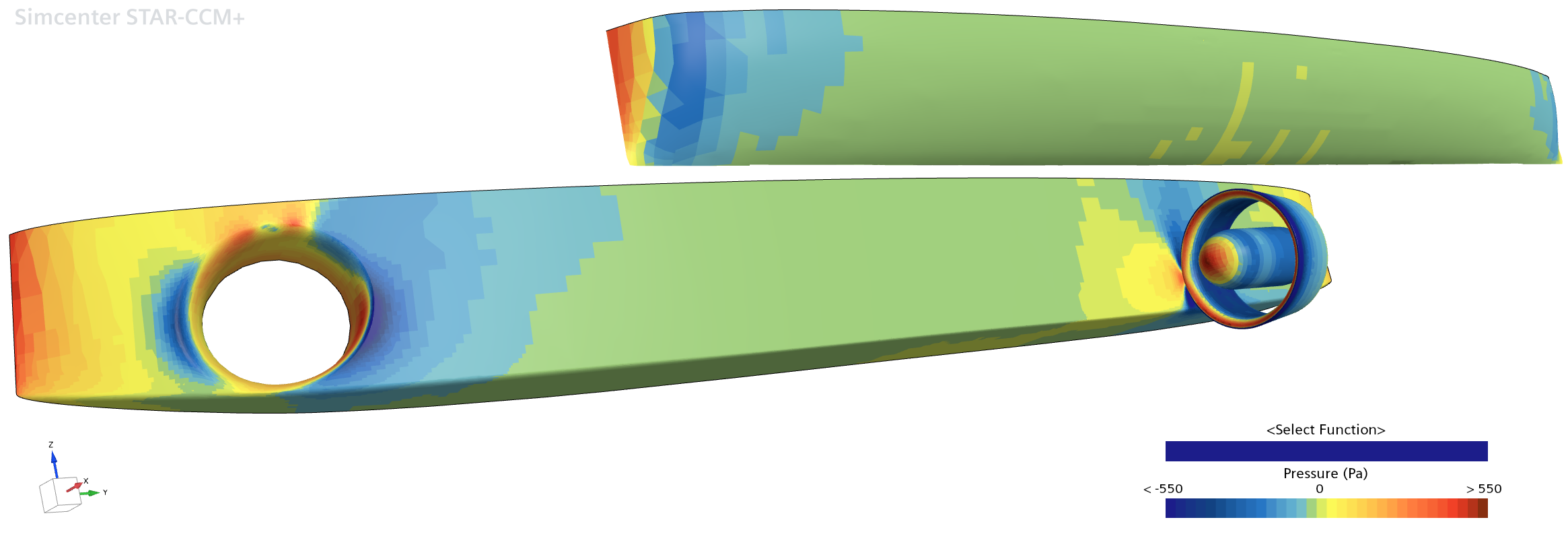
For this continuation of my previous project (https://sifblogg.uia.no/process-overview-for-asv-hull-design/) the scope was to learn how one can use CFD software, here, that being Star-CCM+, to understand more about the performance of an ASV.
The ASV in question is the same one that was developed alongside the last project, a 1.4 m vessel supposed to never exceed 5 knots in use.
For time management, there was a need to simplify the problem somewhat, and the results show a potential for refinement in the simulation setup. At the same time, I find that I understand a lot of things better now than when I started. Probably not surprising I now understand the use of Star-CCM+ better, I used some of Siemens’s premade tutorials to gain some familiarity with it, but found a lot more use in trial and error while chasing the end result. For me, hitting walls, tho sometimes giving rise to a need for a break, provides the best learning. Simultaneously, I personally see a greater connection between the physics I have learned elsewhere and the plots on the screen. I also see that the resources used for the hull design have a reason for being so recommended, though not a part of this project, I would hazard a guess that the performance is far better for this hull compared to the first-gen hull.
I have also, as last time, produced a report of my procedure while working and the results found. It was a lot of work to get the CAD files ready for simulation, and I had a period where I naively followed an internet tip that resulted in days of meshing and failure. In the end, the results are rougher, and the simulation is simpler than I wanted. At the same time, with also having courses and a student organisation to spend time on, this is the result I ended up with.
That conclusion might sound like I am disappointed, but that is not the case at all! I have, as stated, learned so much this semester in my continuation of hull design procedure. My hope is that this work continues to inspire students at UiA to both try their own approaches and to further develop where I stopped.
Thanks to my mentor for the project, Ali Poursina for all the support, and Souman Rudra for the guidance in my approach to the CDF setup.
The full report is available at SeaBotics:
https://docs.google.com/document/d/17PWEQOtAmw4AGIhQWnIGqX44oIchfq9ucvOdDmMA7y8/edit?usp=sharing
The attached picture shows the calculated velocity on the surfaces of the ASV.