
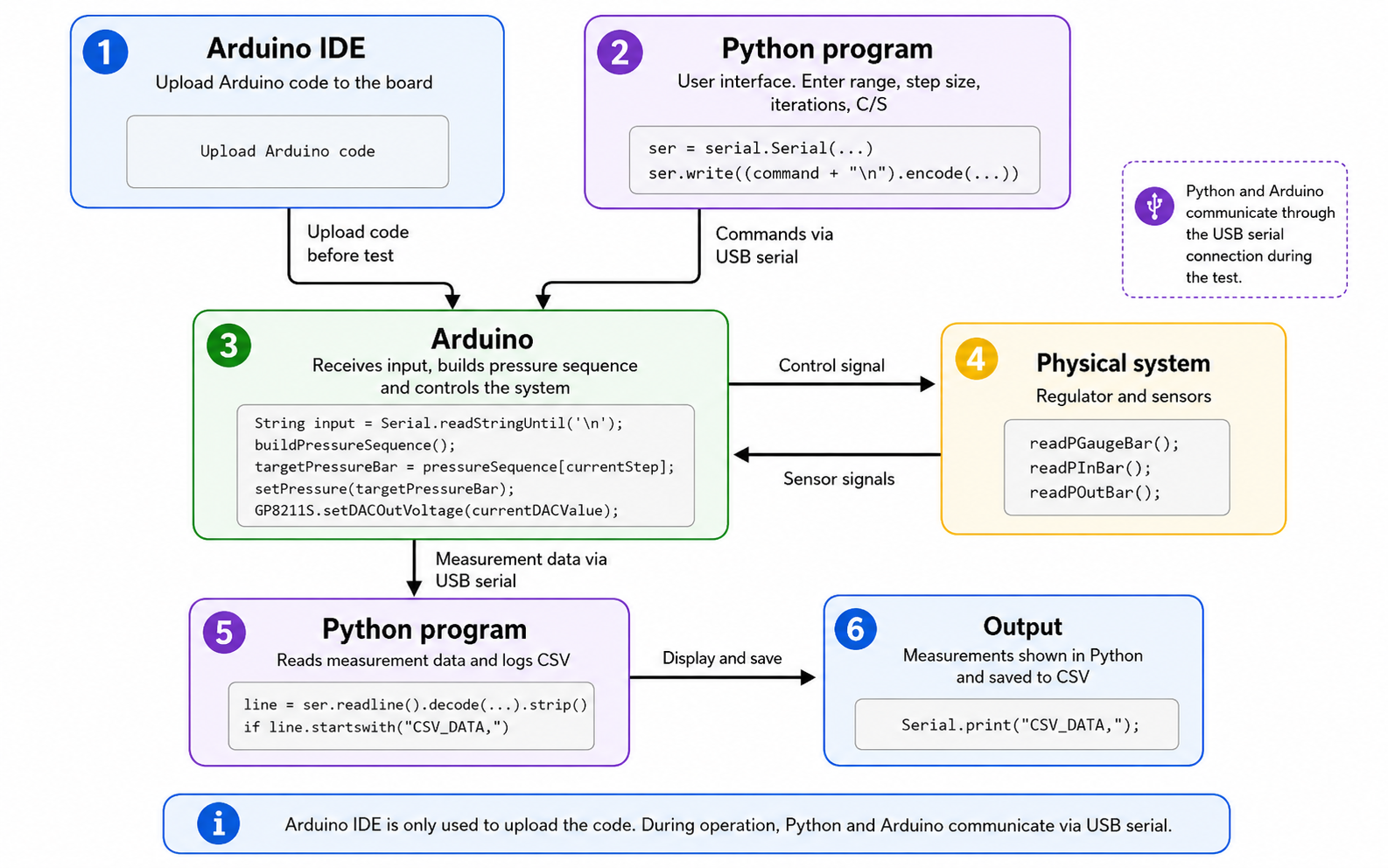
The objective of this project was to fully automate the permeability measurement setup, making the measurement process less time consuming.
During this project the most crucial step was to be able to control the pressure regulator, using Arduino hardware and corresponding IDE software. The first step was to connect the pressure regulator to the Arduino hardware and establish communication between them. After exploring different possibilities, it was decided to use analog (in and out) signal to control the regulator.
The first version of the analog signal gave rough controlling of the pressure setpoint. Here we used a low-pass filter, combined with Arduinos pulsating signal (8-bit digital-to-analog converter (DAC)) that mimics an analog signal. This solution contained a lot of noise, and we were not satisfied with the resolution obtained of around 0.5bar. Therefore, we decided to switch out this solution with 15-bit DAC. This change improved the control signal between step 3 and step 4 in the flowchart, as shown in Figure 1. This enabled us to get smaller step size on the pressure, of less than 0.1bar (equivalent to 20% improvement).
After making the communication from the Arduino to the regulator stable, we started coding. Here we used ChatGPT as a resource to help with the coding. The idea was to build a code that runs a “pressure-cycle”, in precise pressure steps. The program also needed to be user friendly, making it possible for the user to easily adjust parameters as desired. Finaly, we needed to build a program able to log the readings from the pressure cycle and save it as a csv file, to simplify the post data processing. This was achieved by using Python and its “pyserial” library.
To measure the inlet and outlet pressure, we were supposed to install pressure sensors. This was going to enable us to convert the current signal from the pressure sensors to a pressure value in the Arduino. However, after connecting the first current sensor, we ran into some issues. The readings from the current sensor had a great mismatch compared to the actual pressure values. Therefore, we needed to calibrate the code. To do this we took measurements of the current on different pressure levels. These results were used, combined with AI, to calibrate the output of the current sensors. After calibration, the results were better but still did not fully satisfy the accuracy wanted (0.25% of full scale).
Therefore, this project resulted in a semi-automated version of the permeability measurement setup. Minor improvements to make it fully automated are to set the pressure control program to use not only time as a control parameter but combined with the gas flow rate. Finaly, the ambition is to start measurements of in-plane permeability of Li-ion battery components (electrode and separators) and publish the results (by the end of 2026), because to the best of our knowledge the in-plane properties of these components has never been published anywhere.