
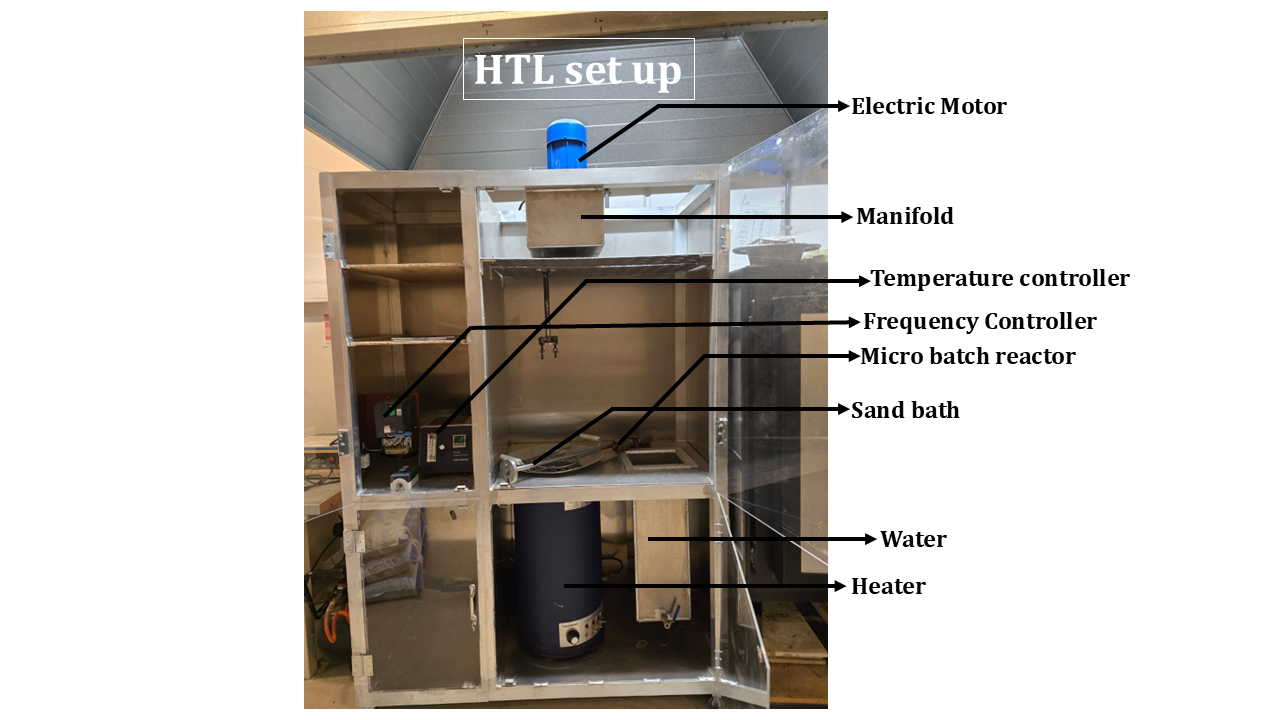
This student project became part of a larger research initiative on improving renewable fuel processes at UiA. Even though the original title focused on hydrodynamic cavitation, my work took a different but very interesting direction. My main task was to carry out Hydrothermal Liquefaction (HTL) experiments using biomass and document the entire preparation and testing process.
I started by learning how the laboratory equipment worked. This included understanding safety routines, getting familiar with the HTL reactor, and going through earlier documentation from the lab. After that, I spent some time reading research papers to understand how HTL converts wet biomass into bio-oil under high pressure and temperature. This helped me design a practical methodology for preparing the biomass samples.
Once the plan was ready, I began working with the actual biomass. I prepared eight samples in total. Each sample had to be dried, ground into fine particles, and mixed with water to make a slurry. Before putting the samples into the reactor, they also needed to be preheated. These steps took much more time and attention to detail than I expected, but they taught me how important preparation is in experimental work.
When the samples were ready, I loaded them into the HTL reactor and monitored the process. Seeing the material go through such dramatic physical and chemical changes was one of the most exciting parts of the project. I also documented every step carefully so the results could be compared later and used by others working in the lab.
By the end of the project, I had completed all eight HTL experiments and produced clear documentation of each stage of the work. Overall, I learned a lot about experimental research, laboratory routines, data logging, and how biomass can be turned into renewable fuel. I also developed a better understanding of how long and detailed scientific work actually is. This project has strengthened my interest in renewable energy and motivated me to continue learning in this field.