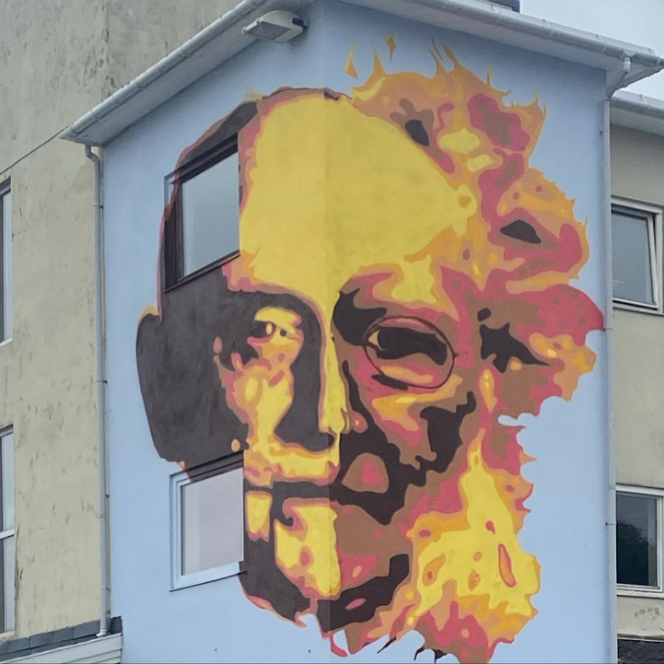
In collaboration with street artist Arne Vilhelm Tellefsen / Deconform AS and Kunstsilo, we are developing a mobile application for documenting and promoting street art in Kristiansand.
This blog covers work done as part of two Student in Research and Innovation projects at UiA:
1) Kristiansand Street Art App: Archive and Cataloguing System.
2) Kristiansand Street Art App: Tourist and Inhabitant Interface.
When we began exploring the idea of developing the app, our first focus was to understand the problem and what was actually needed. We spent time researching how similar cultural and art-based platforms operate, what visitors expect from a digital experience, and how the app could translate into a functional and engaging application.
Through our initial study, we were able to outline the essential foundations for the project. We identified the type of content the app must support, the design direction, and the core features that would offer real value to both local visitors and international users.
This early research helped us to clarify what the app should achieve and how it should grow in the future. Once we shaped the big picture, we started gathering structured requirements to guide development. We focused on what the app should display, how the user should interact with artworks, how staff can manage and update content, and what technical environment would best support long-term scalability. All these points gave us a clear roadmap and ensured that every decision was connected to the project’s vision.
Until now, we have been working under the Waterfall model, which helped us collect and finalise all key requirements before moving forward. This approach was useful in establishing clarity during the early stages. However, as the project evolved, we found that a more flexible and quality-focused approach was needed. Now, when moving forward to the development side of the app, a test-driven approach using unit testing will serve us better because it allows early detection of issues, more stable feature releases, easier maintenance and updates, and faster iteration on ideas. To support this, our recommendation is to use Python-based APIs, as they provide reliability, speed, and strong compatibility with modular testing.
With solid research behind us, clearly gathered requirements, and an improved development strategy, we are ready to build the next phase efficiently, confidently, and with a future-ready mindset.
As we progress into the next phase of development, our focus will shift towards bringing the app to life. Our upcoming work includes developing the frontend interface, building up the backend system with Python APIs, implementing content management tools for the team, integrating interactive user features to enhance the visitor experience, creating a stable testing environment using unit testing, ensuring the app is scalable, user-friendly, and ready for real-world use, and preparing for beta testing, feedback collection, and final refinement.
We are delighted to have received the opportunity to work on the development of this application. This project has been a valuable, insightful, and truly enriching experience for us, allowing our team to grow, learn, and collaborate while building something meaningful.