
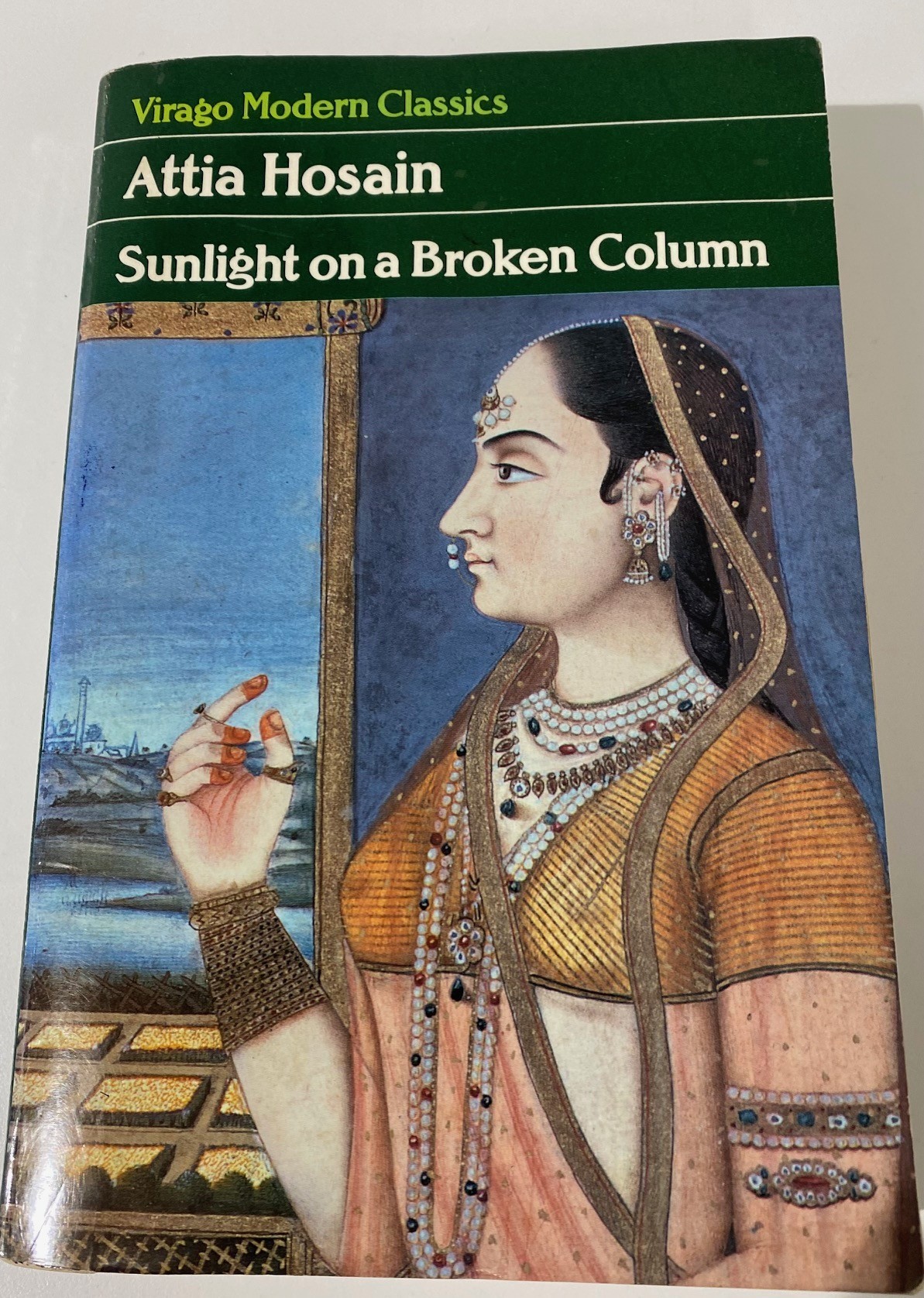
I have been a part of the MaRGAN or Mapping Religion in the Global Anglophone Novel, 1890-1980 (MaRGAN) project since last semester and this spring, I had to do the second round of analysing a novel for the project. The novel I analysed is called Sunlight on a Broken Column (SBC) and was written in 1961, by Attia Hossain. It was not my first choice, but boy, am I glad I got this novel assigned to me because its been one of the best things I have read in a while.
The work itself was simple and it helped that we had done one round of the same thing last semester. After going through the novel assigned to me, I had to pick out keywords (from a list of 32 pre-defined keywords all related to religion) that applied to it. The keywords I chose were ‘Community’, ‘Belief’, ‘Institutions’, ‘Ritual’ and ‘Critique’ as I felt these were featured prominently in the novel and are absolutely essential to understanding the novel. For instance, SBC prominently features an Indian Muslim taluqdari community, a sort of feudal elite that existed during British rule in India, and while it features their beliefs and rituals, it can also be read as a critique of the hypocrisy and untenability of their position in a soon to be independent India. I also had to write an approximately 150-word explanation for each of the keywords I picked. In my work, I also felt that identity or religious identity was an important part of the story, but since it was not part of the pre-defined keywords, I could not choose it. This indexing by keyword should help future researches to quickly search the prominent novels of the last century which feature a certain theme, for eg: the critique of religion, or, conversely, to search which prominent religion related themes were part of a particular novel.
This is basically the objective of project MaRGAN which is trying to create a database that can be used by future scholars to study the changing attitudes towards religion and its representation in literature through the twentieth century and beyond. As a starting point, the project aims to define a corpus of approximately 400 global anglophone novels (published between 1890-1980), and categorise representation of religion in terms of the 32 pre-defined keywords which I mentioned above. In the last semester, me and my colleagues, Andreas and Christer had decided (with Professor Jamie Callison’s approval) that we would restrict ourselves to picking the 5 or 6 most fitting keywords in a novel and that is what I did this time as well. The reason for developing this ‘rule of five’ was that many novels featured a variety of different themes in major and minor ways, and we often found it hard to decide where to draw the line in terms of the number of keywords. After discussion, we decided to stick to only those keywords that were absolutely essential for understanding the novel, and we found that usually every novel could be best explained in terms of 4-6 keywords.
Apart from the religious keywords, we also had to categorise the works according to pre-defined codes for the religions and countries that influenced their work as well as the religions and countries featured in the novel. This would also allow the researchers to plot maps and visually depict the changing representations of religion in novels over time or the contrasting attitudes towards religion and its depiction in literature in different parts of the world.
This was the second time I was doing this exercise, and it worked out a lot easier than last time. All in all, this has been a rewarding and learning process and I really hope that researchers will soon be able to use this database.