
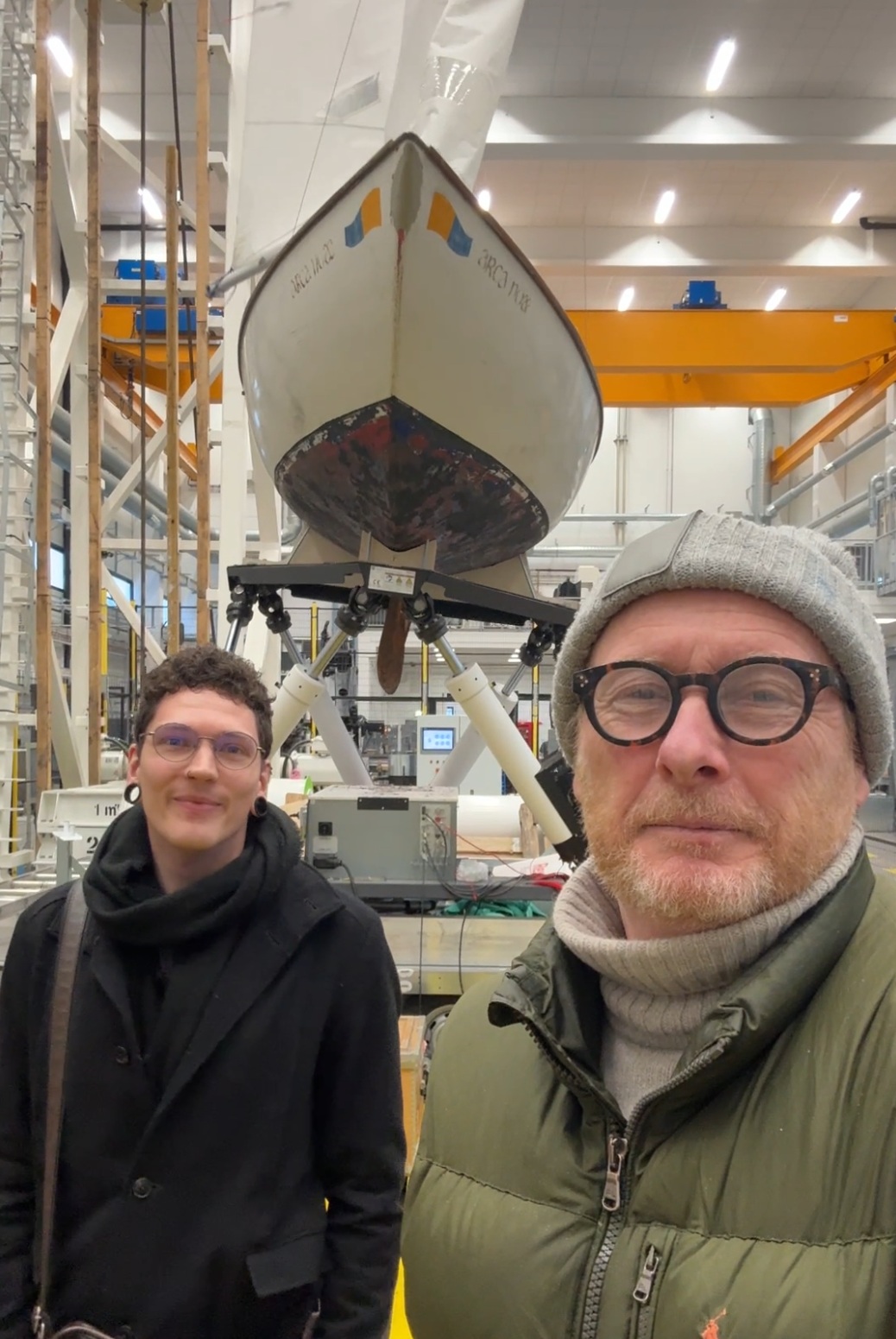
Stormen is an art installation by Norwegian artist Per Fronth. At its centre is a sailboat mounted on a mechanical platform whose movement is driven by recorded wave data from the North Sea. The platform translates that data into motion, so the boat rocks and lurches in patterns that match real conditions at sea. The audience walks around the sculpture inside a large exhibition room, while a multi-channel sound system fills the space with musical soundscapes and environmental sound.
Per Fronth initiated the project, and the wave simulator was built in collaboration with the Faculty of Engineering and Science at the University of Grimstad. My role is to realize and expand the sonic dimension of the work, to deepen the audience’s experience and draw them more fully into the storm. This post focuses on the technical orientation of my work on Stormen. The aesthetic dimension is the subject of a separate project. The two are intertwined in practice, but each can be detailed on its own terms.
At the heart of the installation are two systems running in parallel that need a common clock. The wave simulator drives the platform, and the audio system delivers the music and soundscape. They have to begin together and stay aligned through three musical variations as the storm unfolds.
The wave simulator runs a quasi-deterministic sequence, meaning the overall dynamic curve is fixed, but small variables shift things slightly each time. My soundscapes, played back from Ableton Live, needed to begin in sync with that sequence and step through its variations on cue where the two remain interlocked.
To solve this, I sat down with Daniel Hagen and we wrote a Python script that listens for the wave simulator’s start and stop signals, and sends MIDI messages through a virtual MIDI bus into Ableton. Each trigger advances the music to the next variation. When the storm starts, the music starts. When the storm progresses to its next act, the music follows. From the audience’s perspective, none of this is visible. They experience a sculpture and a soundscape that move as one.
A stereo setup couldn’t carry a sculpture that the audience walks around. I designed a multi-channel audio system around twelve speakers, arranged in two separate rings. Six speakers surround the boat and point outward, while six more are placed along the perimeter of the room and point inward, toward the audience and the sculpture. This setup lets the boat and the room interact, drawing on the full spatial range to envelop the audience in the storm. The audio itself is organized in three layers, each with its own job in the room.
The first is diegetic, sounds that are perceived to belong to the boat itself and the atmospheres around it. Textural detail, the creaking of the hull, a sense of physical presence. These play from the sculpture and draw the listener in.
The second is the musical layer. The score originates from the boat itself, but extends outward into the surrounding field, enveloping the audience and giving the music a presence that fills the room. As the wave intensity builds, the musical field expands with it.
The third is environmental. It places the audience firmly inside the soundscape, providing directionally independent sound cues that simulate a real physical environment around them.
What I take from this part of the project is how productive and informative the technical orientation has been on the creative process. As a media composer, I’m used to scoring to moving picture. Stormen offered a new variant of that practice. I recorded the boat’s movement sequence and used it as a dynamic guideline for my composition, interpreting raw intensity data and translating the emerging structure into familiar musical terms.
The wave data revealed a natural dramaturgy in the storm’s behaviour, a rising and falling intensity I could shape my score around. The chaotic, partly random character of the waves also led me to introduce chance-based playback into certain sounds, so the piece responds similarly to the simulator’s small variations and never plays exactly the same way twice.
The technical foundation now stands. The public installation has yet to take place, but the systems are running and the open sea lies ahead.