
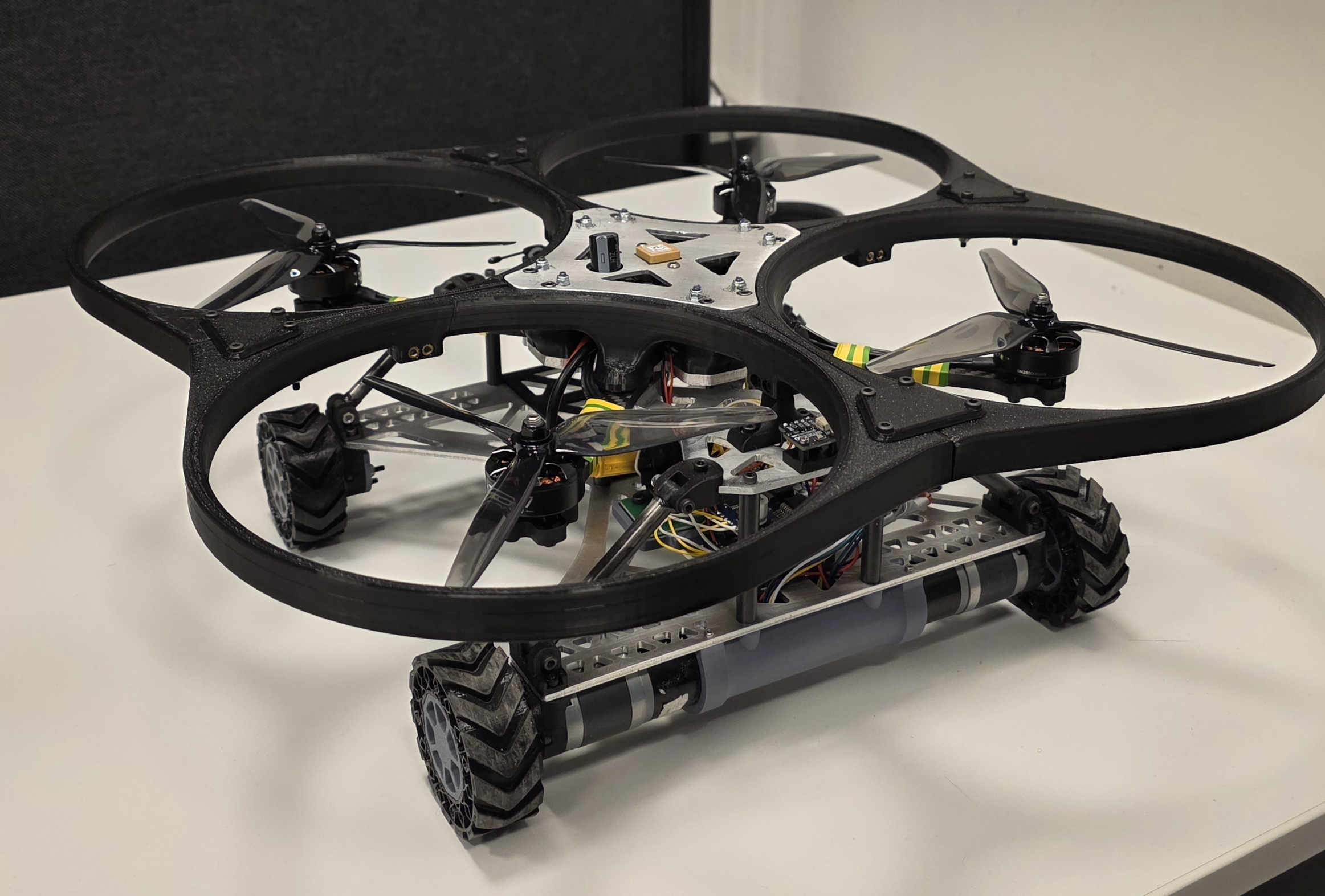
In the project “Integrated modelling of a hybrid robotic platform” at the University of Agder, I have worked on modelling a robot that combines wheel-driven movement with four rotors. My focus has been on learning how to build a simulation model in Simscape and creating a foundation for exploring how the robot behaves.
The starting point is a physical prototype developed in an earlier bachelor’s project. It brings together wheels for ground travel and rotors for flight in a single platform. Combining these systems raises questions about how they influence each other, and how changes to the robot’s design or control systems might affect its movement.
I have used Simscape together with MATLAB and Simulink to represent the robot’s mechanics, wheel drive, rotors and contact with the ground. Building the model involves describing how the components are connected, how forces act on them and how motion is transferred through the structure. It requires translating a physical machine into a form that a computer can simulate.
Learning this process has been a central part of the project. A robot’s behaviour depends on many connected details, including its mass, the placement of components, motor forces and friction against the ground. Working through these relationships has helped me understand both the modelling tools and the physical robot better.
The aim is to use the model to test different implementations and investigate their effects. These could include a different control system, a change in weight distribution or a modification to the mechanical structure. A simulation provides a way to explore such ideas and examine the resulting behaviour before making changes to the prototype.
One example is the interaction between rotor lift and wheel contact. When the rotors pull upwards while the robot is still on the ground, the wheels press less firmly against the surface. This can affect both turning resistance and grip. Understanding this interaction requires considering the wheels and rotors together, which is one reason an integrated model is useful.
The project has given me practical experience with Simscape and a better understanding of how the robot’s mechanical and control systems interact. The model provides a foundation for exploring design changes and control strategies. Comparing simulation results with measurements from the physical robot will be an important next step in assessing its accuracy.